
O-Rings for High Temperature Applications
Selecting the right elastomer for sealing in extreme heat environments

Why Temperature Rating Matters
When o-rings are exposed to temperatures beyond their rated limits, the elastomer degrades rapidly. Cross-linking breaks down, the material hardens or cracks, and compression set becomes permanent. The result is seal failure, leaks, and potentially catastrophic equipment damage.
Standard nitrile (Buna-N) o-rings are rated to about 120°C (250°F). For applications above that threshold—heat exchangers, engine components, chemical processing, aerospace systems—you need specialized high-temperature compounds.
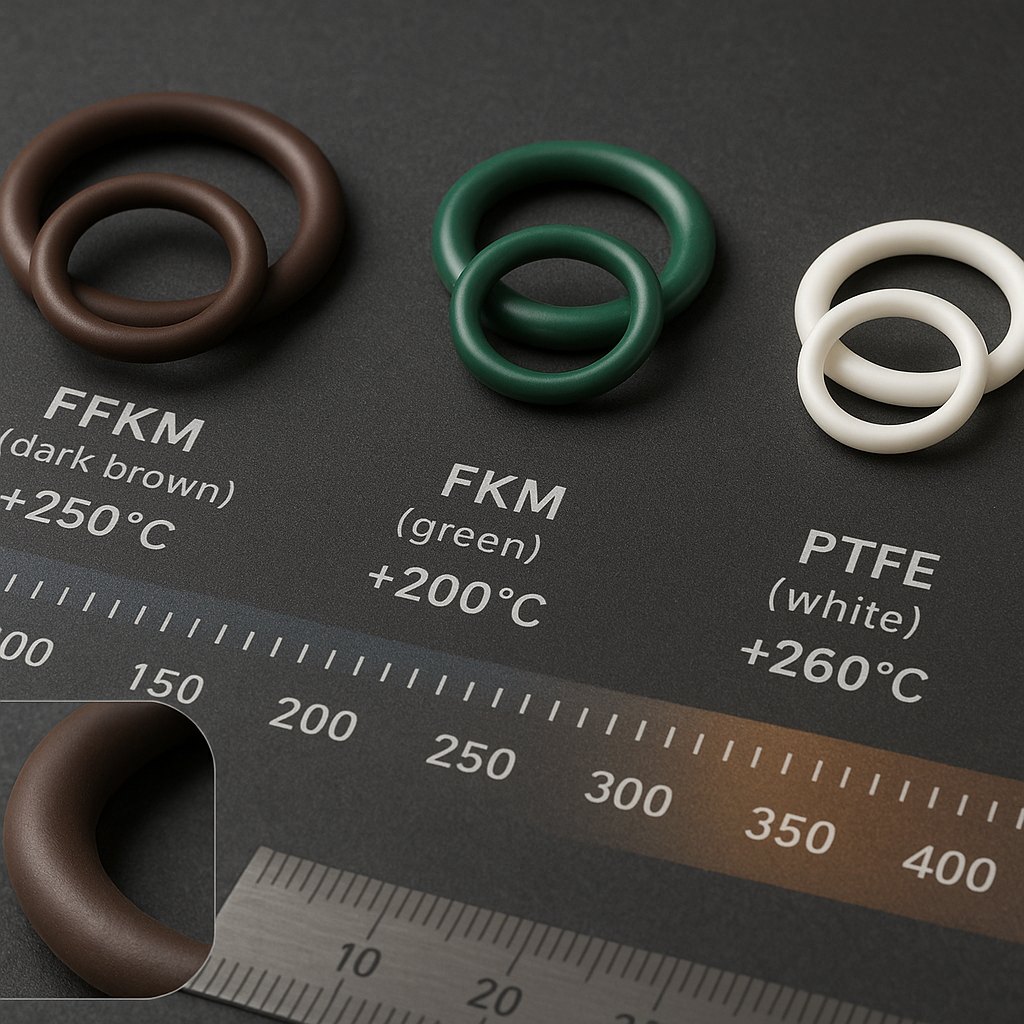
High Temperature O-Ring Materials Compared
Silicone (VMQ) — Up to 230°C (446°F)
Silicone o-rings offer excellent heat resistance and remain flexible across a wide temperature range (-60°C to 230°C). They are ideal for static sealing in food processing, medical devices, and HVAC systems. However, silicone has poor abrasion resistance and limited chemical compatibility with petroleum-based fluids.
Fluorocarbon (FKM/Viton®) — Up to 200°C (392°F)
FKM is the workhorse of high-temperature sealing. It resists most oils, fuels, hydraulic fluids, and many chemicals while handling sustained temperatures up to 200°C. FKM o-rings are the go-to choice for automotive, oil and gas, and chemical processing applications.
Perfluoroelastomer (FFKM/Kalrez®) — Up to 327°C (620°F)
FFKM provides the ultimate combination of chemical resistance and temperature capability. These o-rings handle virtually all chemicals and the highest continuous service temperatures of any elastomer. The tradeoff is cost—FFKM o-rings can be 50-100x more expensive than FKM equivalents.
PTFE (Teflon®) — Up to 260°C (500°F)
PTFE o-rings are technically not elastomers—they do not recover from compression. They are used where chemical inertness is the primary requirement and the seal design can accommodate their lack of elasticity. Common in semiconductor and pharmaceutical applications.