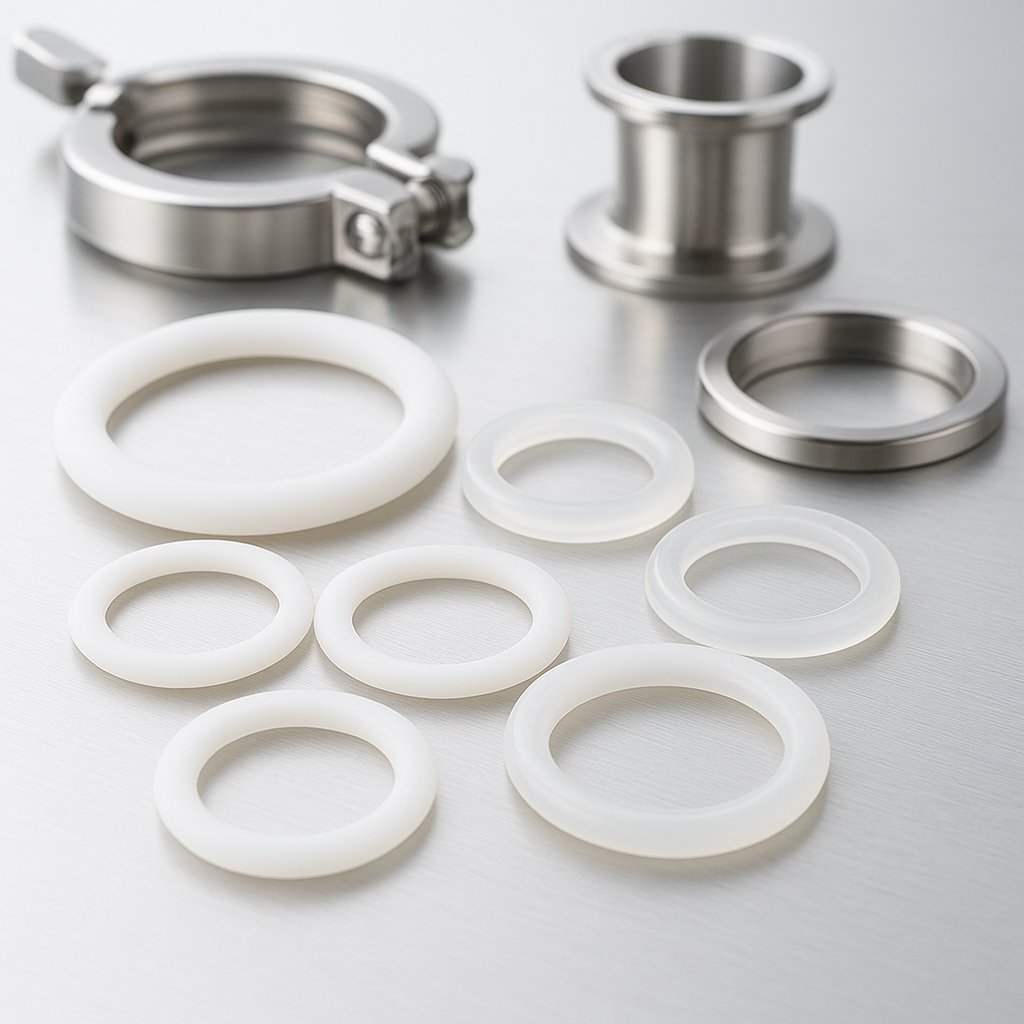
FDA-Compliant O-Rings
What you need to know about seals in food processing and beverage systems
Regulatory Requirements
Any elastomer that contacts food or beverages must comply with FDA 21 CFR 177.2600. This regulation specifies which base polymers, fillers, and curing agents are permitted. Simply being made of silicone does not automatically make an o-ring FDA compliant.
Common FDA Materials
Silicone is the most popular FDA-grade material due to its wide temperature range, odorless properties, and ease of sterilization. It withstands autoclaving, steam-in-place (SIP), and clean-in-place (CIP) processes.
EPDM compounds formulated for FDA compliance are excellent in dairy, brewery, and water treatment applications. They handle hot water and steam better than silicone at a lower cost.
FKM (Viton) in FDA grades provides chemical resistance for applications involving flavorings, essential oils, or cleaning solvents that would degrade silicone or EPDM.
Beyond FDA: 3-A and USP Class VI
Food processing facilities often require 3-A Sanitary Standards compliance in addition to FDA. For pharmaceutical and medical applications, USP Class VI testing is the benchmark. These certifications involve additional biocompatibility and extractables testing.